
UREAZ
Zabardast Urea
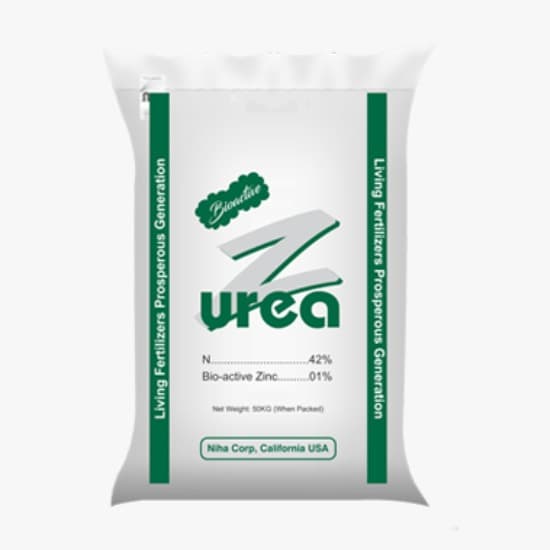
Urea Z is a next generation multinutrient fertilizer. UreaZ is an activated Urea enriched with Bioactive Zinc. Bioactivation of Zinc has been done with patent Bioactivation technology of Niha Corp USA.
It is coated with Bioactive Zinc & activating agents, a blend of Acclimatized Efective Microbes consortium, Microbes Growth promoting Organic material blend. This Bioactivation ensures more nutrient availability to plant and less fixation of Zinc in soil, giving significant higher yield vs classical Urea and Zinc Sulphate.
Nitrogen (N)
42%
Bioactive Zn
1%
Addressing the "Zinc-Immobilization" Crisis
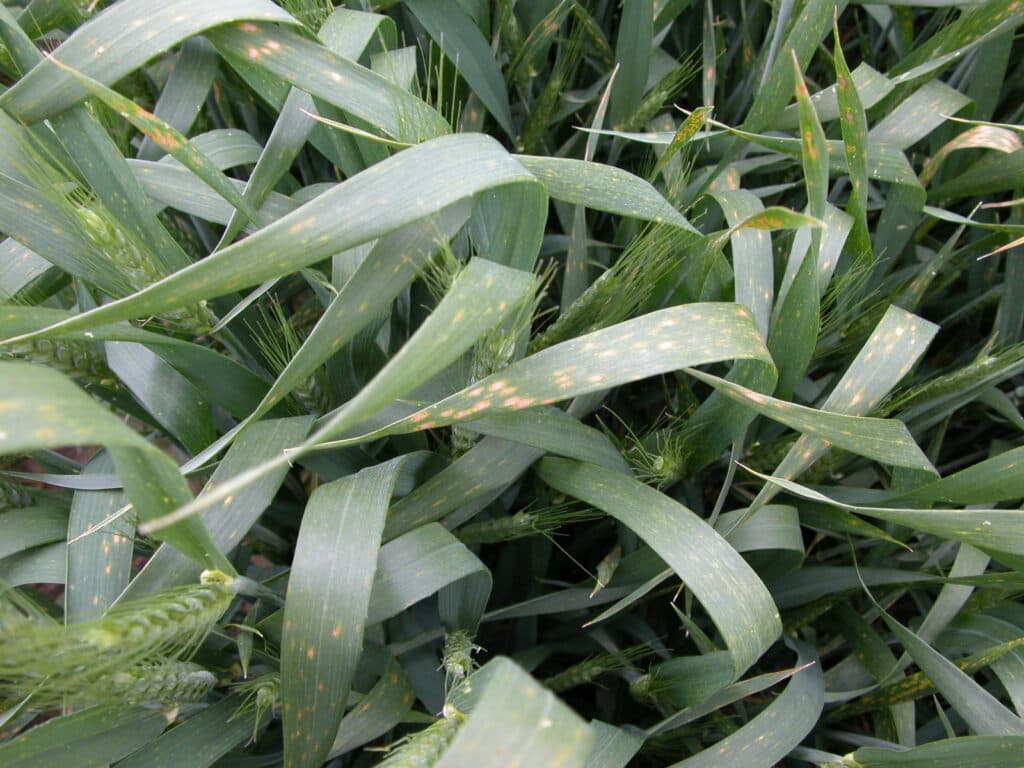
For decades, the agricultural sector faced a critical metabolic bottleneck. Despite the widespread use of traditional urea, essential micronutrients—specifically Zinc (Zn)—remained largely immobile and unavailable to plants due to unfavorable soil chemistry.
This "silent hunger" resulted in stagnant yields, poor crop resilience, and a decline in the nutritional density of global food supplies.
Conventional urea suffers from severe inefficiencies, with a large percentage of nitrogen lost through volatilization, leaching, and denitrification—leading to low nitrogen use efficiency and high greenhouse gas emissions.
A Breakthrough in Bio-Logic Architecting
NIHA CORP disrupted this paradigm by engineering Zabardast Urea, a high-performance formula that transitioned fertilization from a bulk chemical process to a precision biotechnological intervention.
This success was driven by two proprietary, patent-backed pillars:
- 1. Nutrient BioactivationLeveraging our United States-patented technology, we developed a method to "unlock" immobile nutrients by creating a carbon-rich acidic micro-environment at the root zone, making Zinc immediately bio-available.
- 2. Surface Bio-Coating Technology (BCT)We pioneered a unique mechanical bonding process that coats each individual urea granule with beneficial microbes and bioactive nutrients. This ensures a non-migrating, temperature-resistant bond that remains effective from the factory to the field.
Impact & Field Benefits
Zabardast Urea (UreaZ) contains 42% Nitrogen and 1% Bioactive Zinc, fortified with a microbial consortium to improve nutrient uptake. It is coated with Bioactive Zinc & activating agents, a blend of Acclimatized Effective Microbes consortium, Microbes Growth promoting Organic material blend.
Healthy Root System
Healthy & vigorous root system due to synergetic effect of Zinc, PGRM & NSM.
Superior Growth
Lush green and larger leaves due to quick and lasting Zinc supplement. Larger ear with more grains. Healthy crop and more yield.
Extended Vitality
Crop remains green till ripening due to PGRM. Improved crop vigor and yield stability.
Environmental Protection
Organic coating gives less Nitrogen leaching and volatilization. Reduced ammonia volatilization and nitrous oxide emissions.
Nitrogen Efficiency
Significantly higher nitrogen use efficiency (NUE). Lower fertilizer losses and reduced application frequency.
Physical Quality & Biology
Free flowing, no lumps & powder. Enhanced soil microbial activity.
Influence of Zinc Impregnated Urea on Growth, Yield and Grain Zinc in Rice (Oryza sativa)
Qudsia Nazir, Muhammad Arshad, Tariq Aziz and Muhammad Shahid
Institute of Soil and Environmental Sciences, University of Agriculture, Faisalabad
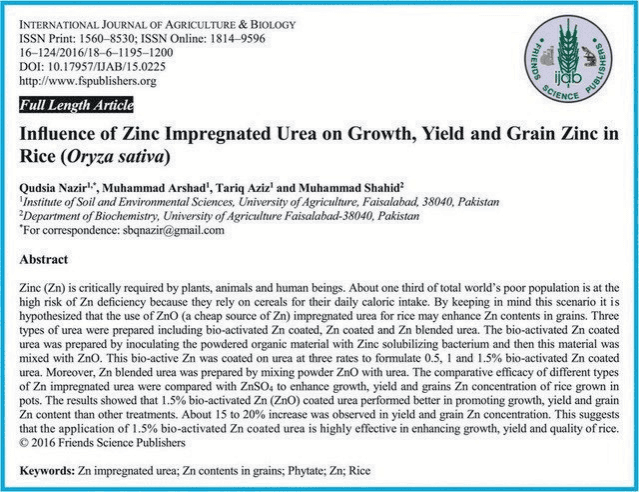
Zinc (Zn) is critically required by plants, animals and human beings. About one third of total world's poor population is at the high risk of Zn deficiency because they rely on cereals for their daily calorie intake. By keeping in mind this scenario it is hypothesized that the use of ZnO (a cheap source of Zn) impregnated urea for rice may enhance Zn contents in grains.
Three types of urea were prepared including Bio-Activate Zn coated, Zn coated and Zn blended urea. The Bio-Activate Zn coated urea was prepared by inoculating the powdered organic material with Zine solubilizing bacterium and then this material was mixed with ZnO. This bio-active Zn was coated on urea at three rates to formulate 0.5, 1 and 1.5% Bio-Activate Zn coated urea. Moreover, Zn blended urea was prepared by mixing powder ZnO with urea.
The comparative efficacy of different types of Zn impregnated urea were compared with ZnSO₄ to enhance growth, yield and grains Zn concentration of rice grown in pots.
"The results showed that 1.5% Bio-Activate Zn (ZnO) coated urea performed better in promoting growth, yield and grain Zn content than other treatments. About 15 to 20% increase was observed in yield and grain Zn concentration. This suggests that the application of 1.5% Bio-Activate Zn coated urea is highly effective in enhancing growth, yield and quality of rice."
CASE STUDY: THE ZABARDAST UREA™ REVOLUTION
Success is rarely a solo journey; it is the result of visionary partnership and relentless innovation. Today, we celebrate a monumental achievement that has placed Pakistani innovation on the global map.
Product Sales Performance
In just seven years, our Nutrient Bioactivation Technology has achieved a monumental 1.2 million tons in sales (22 million bags). As Pakistan's 2025 leader in zinc supplementation, this milestone reflects deep-rooted farmer trust and our commitment to superior crop yields through advanced, high-efficiency nutrient delivery.
Black Dragon Award
Engro Fertilizers wins Black Dragon award at the 25th Dragons of Asia for Engro Zabardast Urea campaign. Engro Fertilizers has been honored with the prestigious Black Dragon Award, specifically for the campaign surrounding Engro Zabardast Urea. While this award celebrates marketing excellence, the heart of the success lies in the product itself-a product powered by NIHACORP.
From the Lab to the Global Stage
Our success is not measured in trophies, but in the health of the earth. However, when Engro Fertilizers took our formula to the market through our royalty partnership, the impact was so profound that it couldn't be ignored. The Black Dragon Award at the 25th Dragons of Asia is a tribute to what happens when a team stays true to its goal. This award, won by Engro for the Zabardast Urea campaign, is built entirely upon the technical breakthrough achieved by NIHACORP.
Why This Success Matters to Us
The Soil First
Our team's primary focus was to fix the nutritional gaps in traditional urea. We didn't stop until we had a formula that truly nourished the soil.
Independent Innovation
This was a victory for NIHACORP's dedication. We worked tirelessly to perfect this product, ensuring it was ready to deliver results the moment it hit the field.
A National Pride
Seeing a formula developed by our team lead a major partner like Engro to an international award within just a few years proves that our local innovation is Solving World Problem.
The BioTech Revolution: Efficiency Comparison
By switching to Bioactivated Urea (Zabardast Urea / UreaZ), farmers see a drastic shift in metrics. Fertilizer Use Efficiency (FUE) doubles, while harmful leaching is cut in half.
| Feature / Metric | Standard Urea (STU) | Zinc-Coated Urea (ZNU) |
|---|---|---|
| Nitrogen Release | Rapid (High Waste) | Controlled (Slow-Release) |
| Nutrient Count | 1 (Nitrogen Only) | 2 (Nitrogen + Zinc) |
| Volatility | High (Lost to air) | Significantly Lower (Retained in soil) |
| Application | Soil Only | Soil, Fertigation, Foliar (Water Soluble) |
| Crop Yield | Baseline | +20% Increase |
| N₂O Emissions | Baseline | -50% Reduction |